
The Problem With Calling Everything AI-Generated
Even experienced readers cannot reliably spot AI writing, so why are so many of us becoming judges? I think the answer is a fear that the research quietly confirms.
I have been publishing a lot of content lately, and the comments keep showing me a dark pattern. Readers are very sure about how a piece was made, and many judge that AI wrote it.
Plenty of them come from technical writing and content backgrounds, and some call themselves AI enablement specialists, so judging AI output is part of their daily work. I would expect them to be best placed to tell human writing from machine writing, yet in my observation they often cannot.
For most of us, AI has become the default guess, even when the content is not AI-generated. Let me tell you why.
By the way, I teach and mentor aspiring tech writers and am also the author of the book AI-Native-Technical-Writer. I also publish courses on API documentation using AI; do check out below
https://satyaseel.gumroad.com/l/tlapqh
A piece can be written by a human, assisted by AI or generated by AI. Nearly everyone uses AI somewhere in their work now, but writers are unlikely to be the one group that stays away from it. Someone who writes every paragraph by hand and then asks a model whether the structure is clear has not handed over authorship, so calling the result "AI stuff" flattens a wide range of practice. I do not think the explanation is carelessness or bad faith because low-quality AI content bloat is real.
But research points to something underneath the comments, and I think it explains why the verdict comes so fast after seeing any online content these days.
A fear that rarely gets said out loud
A 2026 study in Frontiers in Psychology found that workers who see a real risk of being replaced by AI report a weaker sense of professional identity and less meaning in their work, and they feel less secure in their jobs (Frontiers in Psychology, 2026). Studies of writers show the same thing closely.
In a survey of 52 Finnish professional writers, a quarter saw AI as an outright threat to their livelihoods, and the writers who refused to use it treated that refusal as a way of marking the edge of their professional identity (Finnish writers study). In another interview with 25 writing professionals, those who resisted AI used that resistance to reinforce their professional identity and protect their credibility within their networks.
The closest match to what I see in my comments comes from Archana Raghavan, who interviewed 41 professional writers over eighteen months and followed their online communities. She found writers examining each other's work for signs of AI, which she calls "peer surveillance". She reports that AI felt different from earlier tools such as grammar software because it threatened a core part of their identity, which is creative expression. In her words, suspicion alone was costly, since even suspected AI use could lead to exclusion or lost income, and some writers chose clumsier wording on purpose so that their work would not look too AI-like (Raghavan, The Sociological Review, 2026).
Raghavan calls this boundary work, meaning writers protecting the line between human work and machine work.
I think saying "this looks AI-generated" in a comment is the same move on a smaller scale. It puts the line back where it used to be, and it lets us feel that our eye still works. These studies covered workers and writers in general, and none looked at people who call themselves AI advocates, so my claim that they feel this too comes from what I see in the comments and not from a study.
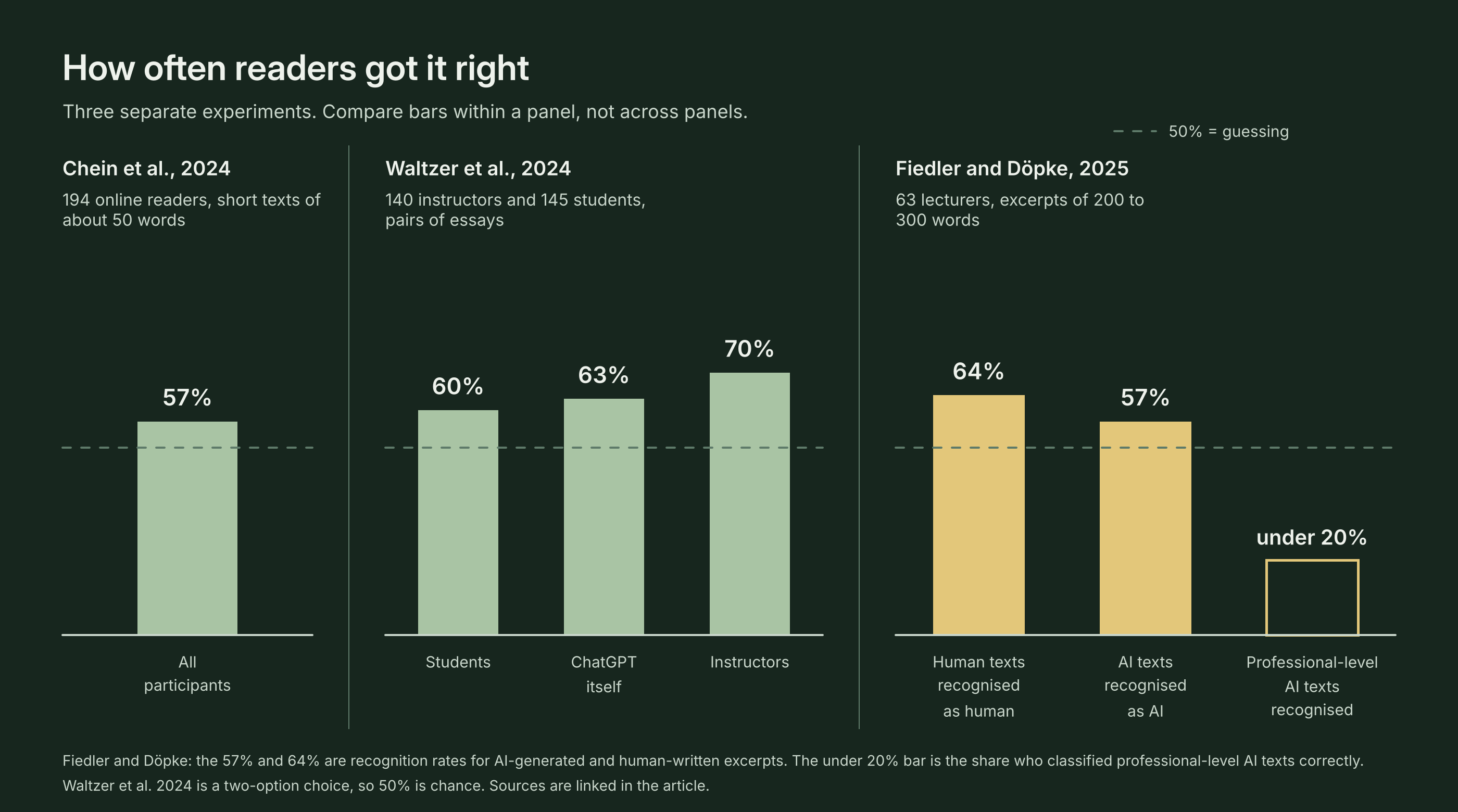
The research says the fear has a basis In a Temple University study, 194 online readers judged short texts and got 57% right, where pure guessing gives 50% (Chein et al., 2024). College instructors did better in another study, reaching 70% against 60% for students (Waltzer et al., 2024). In the result I find most telling, 63 lecturers read academic excerpts and recognised human writing only 64% of the time, which means that experienced academics failed to recognise more than a third of the human-written content as human. When the AI text was at a professional level, fewer than 20% of them classified it correctly (Fiedler and Döpke, 2025).
Get my latest book on AI Native Technical writer.
https://satyaseel.gumroad.com/l/ai-native-technical-writing
ChatGPT took the same test and showed far more confidence than the people did, yet it got only 63% right, and people who were confident in their own ability still struggled. Daily contact with AI did not sharpen the eye either, since a 2026 paper in AI & Society reports lower scores for people who used AI tools more often and in more ways (source). The instructors and lecturers did beat chance, so detection is not impossible, but it is far too unreliable to count as proof. If the line between human and machine writing cannot be found by reading, then it cannot be defended by reading either, and I think that is the part that unsettles people most.
If AI can write this well, and instructors, editors and lecturers cannot tell, then the years spent learning to write clearly stop being visible, and so does the authority of the people whose job is to judge.
A label is a way to restore the boundary
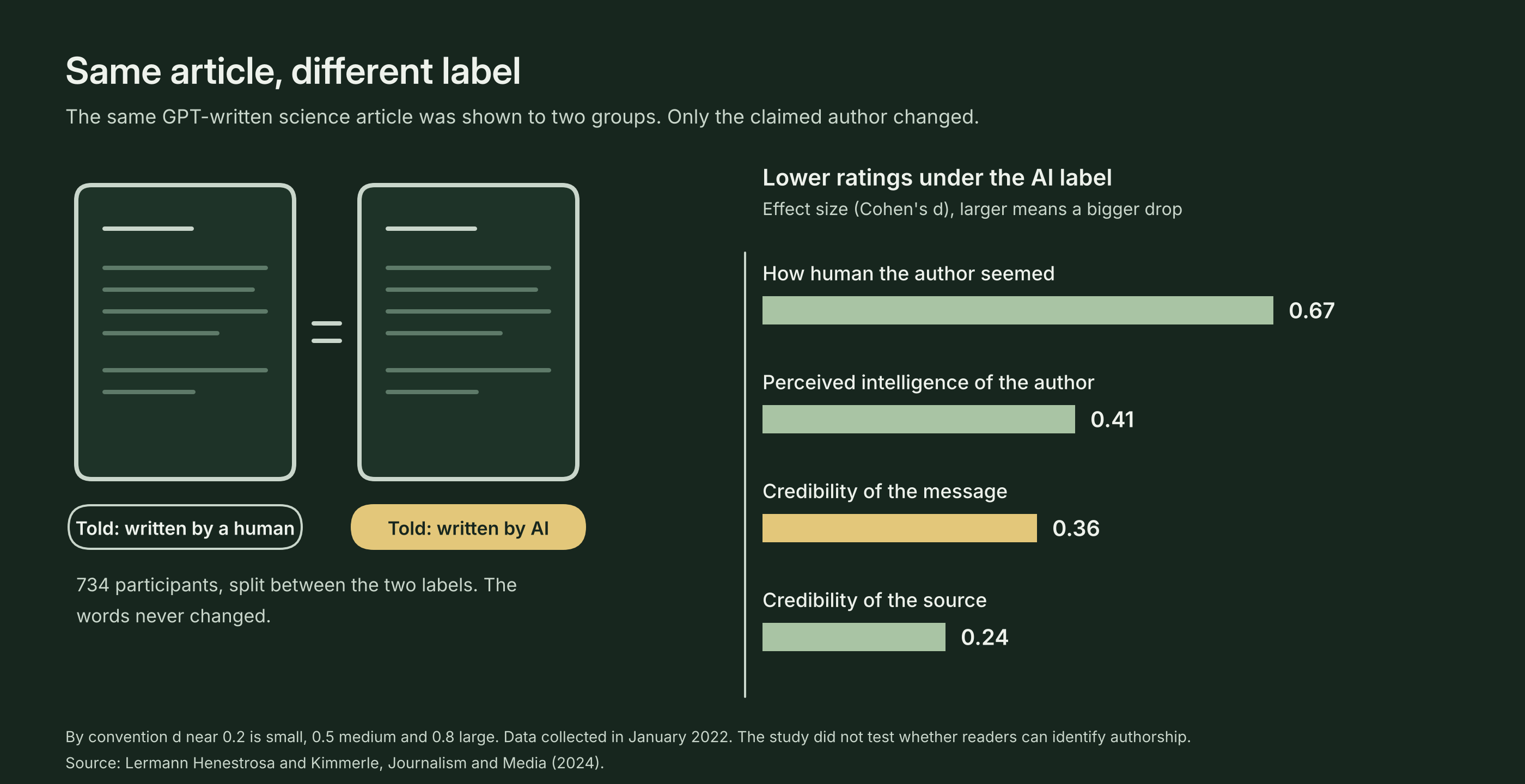
Henestrosa and Kimmerle gave 734 participants the same science article, which ChatGPT had written. One group was told a human wrote it and the other was told AI wrote it.
AI label lowered ratings of credibility, of the author's intelligence and of how human the author seemed, although the words were identical (Henestrosa and Kimmerle, 2024).
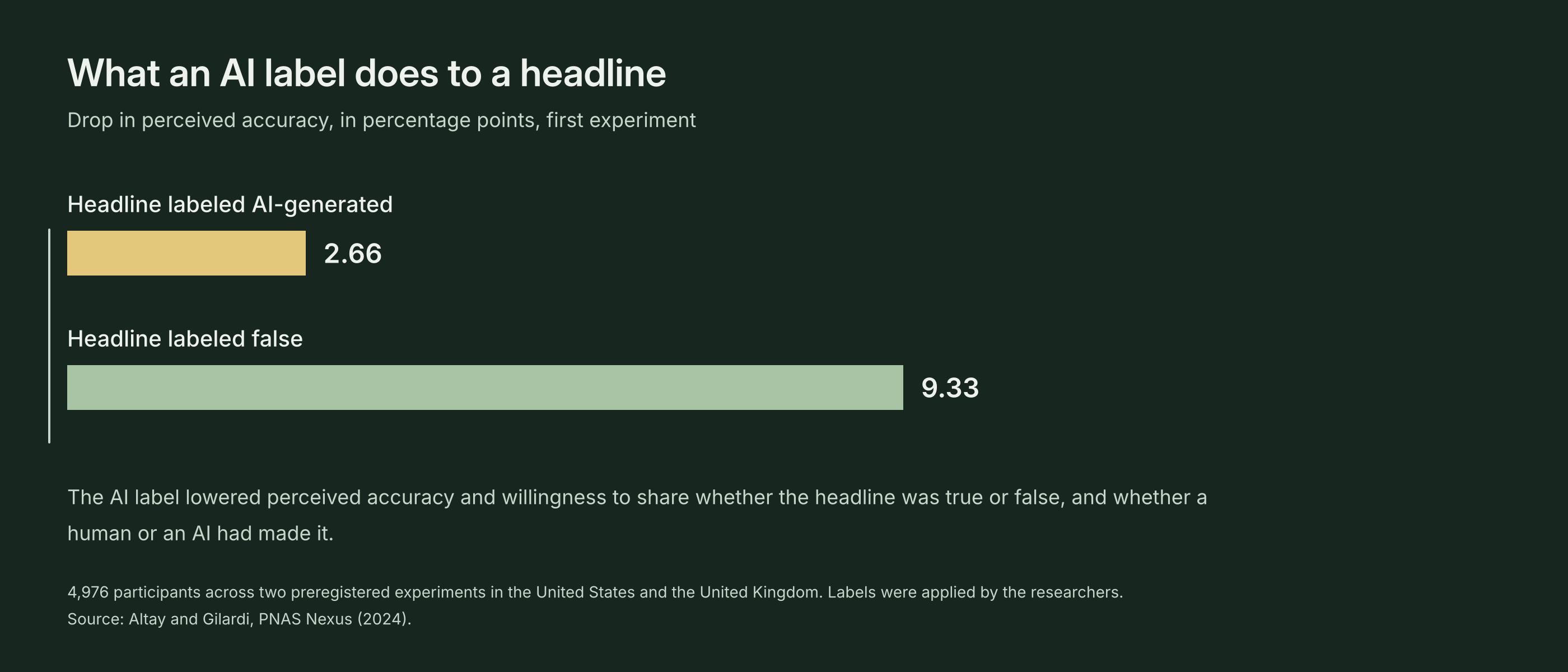
Altay and Gilardi found the same pattern at a larger scale. In two experiments with 4,976 participants in the United States and the United Kingdom, an "AI-generated" label lowered how accurate a headline seemed and how willing people were to share it, whether the headline was true or false and whether a human or an AI had written it. The drop was about a third of the drop caused by a "false" label, 2.66 points against 9.33.
The authors explain that readers assume "AI-generated" means the text was produced entirely by AI with no human supervision (Altay and Gilardi, 2024).
Saying "this looks AI" does not require reading the argument, checking the facts or admitting that the writing is good, and the studies show that it works even when the content is true.
Raghavan's writers show what it costs when it is aimed at a person.
None of the label experiments measured one writer accusing another, since the researchers applied the labels themselves, so the link between the fear and the label is what I think might be the case.
Why AI-assisted is the most uncomfortable category
AI-assisted work blurs the line that the verdict is trying to protect. A person can write with no AI, use a grammar checker, write and then ask AI to review clarity and structure. They can ask AI for a first draft and then research, rewrite, verify and edit it, or generate an article from one prompt and publish it unreviewed. These five workflows are very different, yet most readers have only two boxes for them.
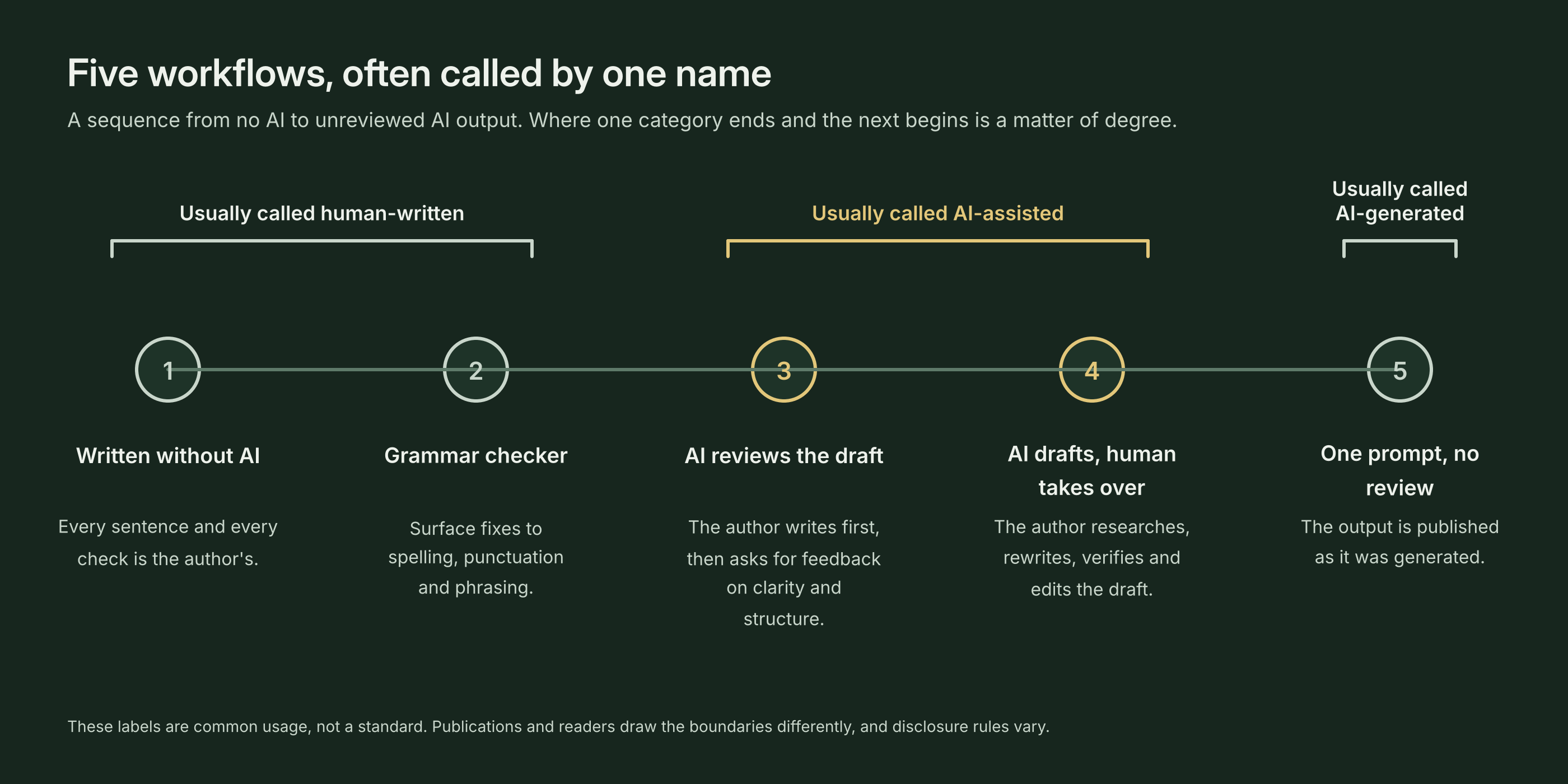
From the research I did, Raghavan reports that:
The fear of being watched pushes writers to see AI use as a choice between genuine and fake, which ignores the many ways AI can assist.
The PNAS study points the same way, because in its second experiment scepticism appeared when people were not given an "AI-generated" or a strong-AI definition, and it did not appear with the other definitions tested.
When people knew what the AI had actually done, the distrust faded. The wider research adds to this, since a survey of 48,340 people in 47 countries found that 66% used AI regularly but only 46% were willing to trust AI systems (Gillespie et al., 2025). What I understand from all this is that, if suspicion alone can cost a writer work, then staying quiet about how a piece was made is a rational choice, and when writers say nothing, readers fill the silence with the least generous guess.
I do not think one universal definition of AI-assisted exists, because the boundary depends on how much of the thinking and wording came from the tool and on what a publication asks authors to disclose.
What stays constant is accountability, since a writer who researches, verifies and edits an AI draft answers for the result just like a writer who typed every word.
What the fear is really protecting
Underneath the fear there is something worth protecting, and it is the judgement behind the words. Technical writers know this better than most.
Clear sentences, consistent terminology and predictable headings were never the whole job, because the job is knowing the product, testing the steps, deciding what the reader needs and standing behind the accuracy. None of that disappears when a model produces a fluent first draft, and none of it can be seen by looking at style.
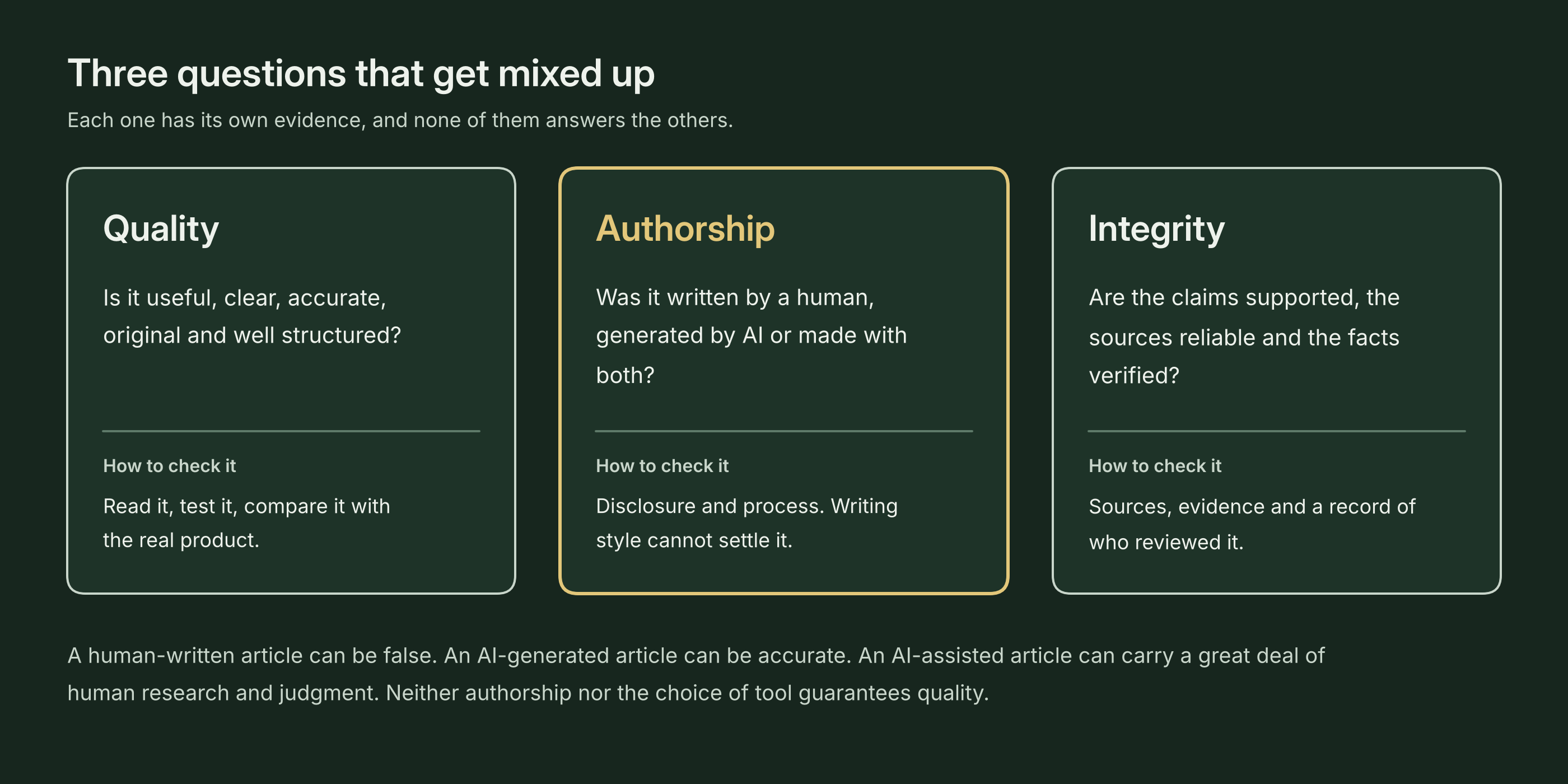
That is why I think three questions should be kept apart.
- Quality: is it useful, clear, accurate, original and well-structured?
- Authorship: did a human, an AI, or both produce it?
- Integrity: are the claims supported, the sources reliable and the content reviewed responsibly?
A human-written article can be false, an AI-generated article can be accurate, and an AI-assisted article can involve a lot of human research and judgement. Quality and integrity are things a reader can check, and they stay valuable whoever or whatever produced the first draft.
After all of this, the research shows four things:
- People cannot reliably tell AI text from human text.
- AI label lowers how the same words are judged.
- The threat of AI weakens workers' sense of professional identity.
- Writers watch each other for signs of AI at a real cost to those who are suspected.
Conclusion
I understand the fear behind all this, but we have become so obsessed with identifying AI-written content that we are forgetting to evaluate whether the content is actually good. People worry about their jobs and about the value of the skills they spent years building, and that worry is real.
The internet has also filled up with so much repetitive, low-effort content that almost everything now starts to feel like AI, and being tired of it is a fair call. However, the research shows how easily that feeling goes wrong. When people were told that a text was written by AI, they rated the same words as less credible. An AI label also made headlines look less accurate and less worth sharing, including headlines that humans had written.
A careful, accurate piece can end up under suspicion for no reason except a guess. Guessing who wrote something is a weak reason to dismiss it. I would rather judge a piece by what is on the page, which means asking whether it is accurate, whether the evidence holds, whether the thinking is original and useful and whether someone took responsibility for it.
What do you think? Comment down below.
About the author
- I’m Harshit Satyaseel, a documentation engineer with 7+ years of experience building developer documentation at TIBCO, Confluent and Suki.AI. I own the developer docs end-to-end, from API and SDK references to docs-as-code pipelines, automation and AI-ready documentation. I’m the author of The AI-Native Technical Writer, and I write about documentation, AI workflows and technical writing careers on Medium, including Level Up Coding. I also mentor technical writers 1:1 on careers, interviews and using AI well in their work.
Comments
Join the discussionI think the distinction between authorship and accountability is especially important in technical content. A document can be AI-assisted and still require substantial human expertise to validate API behavior, test examples, verify edge cases, and ensure the instructions reflect how the product actually works.
The more useful question isn't whether AI contributed to the writing, but whether someone can defend the technical claims and take responsibility when they're wrong. In technical writing, fluency is easy to produce; accuracy requires understanding the system behind the words. That is a much stronger standard to judge content by than trying to identify its author from writing style.
Valid point